

Link to the paper: https://hdl.handle.net/2268/348787
Somewhere in Europe, right now, a factory owner is reading a letter from their grid operator. He was asking for more power. The answer is yes… but in a few years. Meanwhile, forty kilometres away, a wind farm is being told to stop producing. The grid cannot absorb new power injection from the wind farm. The electricity that wind turbines could produce in the next hour will simply never exist.
One problem, one obvious question: why can’t we just move the electricity from there to here? The answer is that lines and cables are reaching their thermal limits. The solution might be to upgrade them. Except that upgrading the infrastructure takes years, costs a lot of money, and requires permits that are sometimes very difficult to obtain.
So in this paper, we asked a slightly ridiculous question and then took it entirely seriously:
What if you put the electricity in a truck?
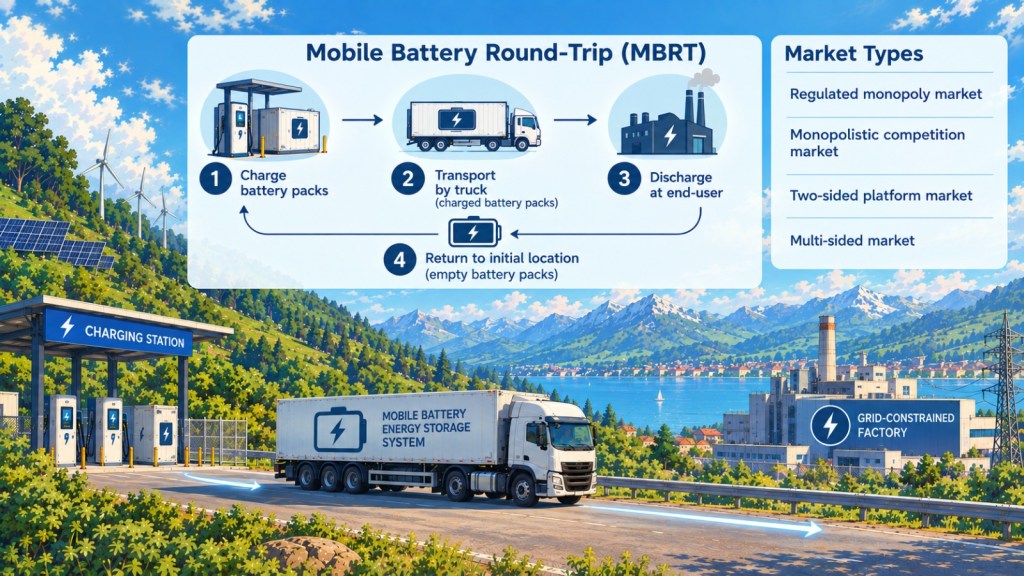
The idea: A battery pack shipped in a standard 40-foot shipping container, sitting on a truck. You charge it where power is abundant and cheap, for example, next to a wind or solar farm that would otherwise be curtailed. You drive it to a site where the load is grid-constrained. You discharge it there. You drive back. We call this the mobile battery round-trip, and it is what our paper is about.
The electricity never touches the congested part of the network. There is no connection request, no permit, no reinforcement. There is a truck, a driver, and a battery. This may sound absurd. Electrons travel at nearly the speed of light through a copper wire. A truck does 45 km/h on average. Physics is clearly not on our side here.
But physics is not the constraint. Capacity is. A congested line or cable cannot move any additional kilowatt-hours without violating network security. A truck on an empty motorway moves multiple MWh, slowly, but it moves them.
What does it actually cost?
Our main contribution is not the concept; others have proposed moving batteries by train, by boat, by autonomous truck. What was missing was a bottom-up cost model, i.e., an explicit euro-per-MWh number for delivering electricity to an end-user this way.
So we built one, from the ground up. Four main components considered: (i) the battery pack and its container, (ii) the truck, (iii) the driver, who, and this turns out to matter, is paid not only while driving but also during the charging and discharging time, and (iv) the losses, since a few percent of the energy disappears on the way in and on the way out.
Add it all up, and delivering a full 3.21 MWh pack costs, depending on the round-trip distance:
Round-trip distance | Delivery cost
50 km | €99/MWh
100 km | €114/MWh
200 km | €144/MWh
These are the costs of the delivery service alone: the truck, the battery, the driver. The electricity itself is extra, and you add it on top at whatever price you paid for it. Which is precisely why the case is interesting. If you are charging from generation that would have been curtailed, that price is close to zero, as the energy was going to be thrown away.
Is it better than a diesel generator?
If you need extra power and the grid can’t give it to you, you might also invest in a diesel generator.
So we costed that too and determined that a diesel generator delivers electricity at €234/MWh.
Depending on the distance of the mobile battery round-trip and the costs of producing the electricity that charges the battery, our proposed solution might be better.
With free electricity (curtailed wind or solar), the truck wins up to a round trip of roughly 265 km.
Above about €75/MWh for the charging electricity, the diesel generator wins at any distance.
This is not a technology that wins everywhere. It wins in a specific corner: short distances, and electricity that is nearly free because nobody else can use it. But that corner is not a hypothetical one. It is for example a wind farm being curtailed not far from an industrial zone that cannot get a connection. That situation exists today, in Belgium, and it is becoming more common.
Who sells it to whom?
A cost model tells you what something costs. It does not tell you how anyone buys it. So the second half of the paper proposes three market structures:
A regulated monopoly, where one provider serves a geographic zone with a price ceiling set by a regulator. A monopolistic competition market, where several providers compete in the same area on price and on delivery speed. A two-sided platform market, where providers and end-users both post orders, i.e., how much energy, when, how far, at what price, and the platform matches them. And a multi-sided market working similarly to the two-sided market, but decouples transport from charging.
It is Uber, for electrons.
Why it matters
The energy transition has a bottleneck, and it is no longer generation. We know how to build wind or solar farms at low cost. The bottleneck is getting the energy from where it is made to where it is needed.
Even though grid reinforcement remains the logical answer, long-term solutions don’t help the factory that needs power this year. Mobile batteries are one of several stopgaps, alongside flexible connections, local production, and stationary storage, and none of them offers the perfect solution. The ideal solution is a site that uses all of them, arbitrating between them with a decent energy management system.
The bigger picture
There is a deeper point hiding in this paper. We have spent a century assuming that electricity is a network good, something that only exists as a flow through a fixed physical topology. Batteries are quietly turning it into also something else: a commodity you can put in a box.
And once electricity fits in a box that can move, it stops obeying the grid’s Kirchhoff’s laws and starts obeying the logistics of everything else we ship. That is a strange thought. But as batteries get cheaper, and they are getting cheaper fast, it is going to get less strange every year.
If you found this article interesting and want to work on this line of research, please do not hesitate to contact Prof. Damien Ernst (dernst@gmail.com).


Leave a comment